A Millionaire’s Mocking Joke to a Homeless Girl That Changed Everything
“If You Can Play the Piano, I’ll Adopt You.”
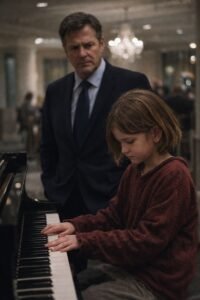 Source: Ai Images
The rain had stopped only minutes earlier, leaving the city sidewalks slick and glowing beneath the evening streetlights. Outside the Grand Aurelia Hotel—where crystal chandeliers shimmered behind towering glass doors—a small girl sat quietly on the cold stone steps, hugging her knees to her chest.
She couldn’t have been more than nine years old.
Her sweater was too big, its cuffs frayed. Her shoes were worn thin at the soles. Beside her rested a small canvas bag—everything she owned in the world. Inside were a half-empty bottle of water and a folded photograph she guarded like treasure.
Her name was Lily.
To most people, she was invisible.
Guests passed without slowing. Some avoided eye contact. Others glanced at her with discomfort, as if poverty were something contagious. Lily didn’t beg. She didn’t cry. She simply sat there, listening.
Inside the hotel lobby, a piano played softly.
That was why she stayed.
Then a black luxury car pulled up to the entrance.
Victor Hale stepped out, phone pressed to his ear, irritation sharp in his voice. He was the kind of man newspapers loved to write about—a self-made millionaire, founder of a booming tech company, a philanthropist at least on paper. His tailored suit cost more than Lily had ever seen in her life. His watch caught the streetlight as he moved.
He noticed the girl only because she didn’t move.
He stopped.
“Why are you sitting here?” he asked, his tone clipped.
Lily looked up. Her eyes were calm—too calm for a child who slept wherever she could.
“I like the music,” she said softly.
Victor frowned. “Music?”
She pointed through the glass doors. The piano.
He let out a short, dismissive laugh. “Do you even know what that is? Piano lessons cost more than most people’s rent.”
Lily nodded. “I know.”
Something about her answer unsettled him. Maybe because it wasn’t desperate. Maybe because it was honest.
Then, half-smiling and half-mocking, Victor said the words without thinking:
“If you can play the piano, I’ll adopt you.”
His assistant stiffened. “Sir—”
“I’m joking,” Victor waved him off.
But Lily didn’t laugh.
She stood up.
Slowly. Carefully.
“Really?” she asked.
Victor hesitated—just long enough to feel something uncomfortable stir in his chest.
“Yes,” he said. “Really.”
Moments later, hotel staff watched in confusion as Victor walked inside, the little girl following him. Guests whispered. The pianist paused mid-practice.
Victor gestured toward the grand piano. “Go on.”
Lily approached it as if it were sacred.
She climbed onto the bench, her feet dangling far above the floor. For a moment, she rested her hands in her lap, took one deep breath—and then she played.
The first note was soft.
Then another.
Within seconds, the lobby fell silent.
Her fingers moved with quiet certainty. The melody was gentle, aching, and raw—like a story told without words. It carried loneliness, loss, and a fragile hope that refused to disappear.
People stopped walking. Conversations faded mid-sentence.
Victor stood frozen.
This wasn’t talent alone.
This was memory. Survival. Soul.
When Lily played the final note, the silence lingered—then applause erupted. Someone near the elevators wiped away tears.
Lily turned, startled by the sound.
“How did you learn to play like that?” Victor asked, his voice lower now.
“My mom,” Lily said. “She cleaned houses. One family had a piano. When they weren’t home, she let me practice.”
“What happened to her?”
Lily tightened her grip on the hem of her sweater. “She got sick. I stayed with her at the shelter until she didn’t wake up.”
Victor swallowed hard.
“And since then?”
“Sometimes shelters,” Lily shrugged. “Sometimes nowhere.”
Victor knelt in front of her.
“When I said that outside,” he said quietly, “I thought I was being clever.”
“You were being mean,” Lily replied gently.
He nodded. “You’re right.”
He looked at her—really looked this time.
“I don’t make promises lightly,” he said. “And I won’t walk away from this one.”
The weeks that followed were filled with paperwork, social workers, and quiet decisions. Victor refused interviews. This wasn’t about headlines.
Lily moved into a guest room in his apartment. The first night, she slept curled up, afraid the bed might disappear. The second night, she asked to keep the light on.
By the third night, she slept through until morning.
Victor bought a piano.
Not for show.
For her.
Every evening, Lily played—not to prove anything, but because she finally could.
Months later, as Lily bowed shyly at a small private recital, Victor stood at the back of the room.
Someone whispered, “You’re a good man.”
Victor shook his head.
“No,” he said softly. “I was lucky.”
Lucky that a careless joke became a promise.
Lucky that a little girl he once mocked taught him how to listen.
And every time the piano filled the room, Victor remembered:
Some of the richest lessons in life don’t come from money.
They come from humility.
Disclaimer:
This story is a work of fiction inspired by real-life themes. Names, characters, events, and details have been altered for storytelling purposes. Any resemblance to real persons or events is purely coincidental. All images are for illustrative purposes only.
Related Posts
-
 An Awkward Dinner with My Daughter-in-Law Led to an Unexpected Lesson
-
 Nosy Neighbor Had Our Cars Towed From Our Own Driveway — What Happened Next Cost Her $25,000
-
 A Soldier Returns Home to Find His Daughter Caring for Her Baby Brother Alone — The Stepmother Vanished Long Ago
-
 My Neighbor Egged My Car for Blocking the View of His Halloween Display – so I Prepared a “Surprise” He Won’t Forget
About The Author