Famous Pianist Asked a Blind Boy to Play “Just for Fun” What Happened Next Shocked Everyone
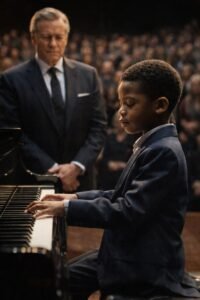
The grand auditorium of Carnegie Hall was bathed in soft light as a special piano masterclass began. On stage stood Alexander Voss, a world-renowned pianist admired for his technical mastery, disciplined classical training, and decades of sold-out performances around the globe. His career had earned him international acclaim—and a reputation for being exacting, sometimes intimidating, with young musicians.
 Source: Ai Images
That evening, Voss demonstrated Nocturne in E-flat major by Chopin, his fingers moving effortlessly across the polished Steinway grand piano. Each note rang with precision, the kind of performance audiences expected from a musician of his stature.
Seated among the crowd was twelve-year-old Jamal Thompson, a blind Black boy from Harlem, attending with his grandmother. Blind since birth, Jamal experienced the world primarily through sound. Music was not merely a passion—it was his refuge and his voice. His grandmother had saved for months to bring him to this masterclass, knowing how deeply he admired Alexander Voss. Jamal held a Braille program in his hands, his anticipation impossible to hide.
When the session opened for questions and student performances, several young pianists confidently stepped on stage and played short selections. Their efforts were met with polite applause and measured feedback. Then Jamal’s grandmother raised her hand.
“My grandson Jamal would love the chance to play,” she said quietly. “He’s been studying piano since he was five.”
Voss looked toward the boy, noticing the white cane and dark glasses. For a brief moment, uncertainty crossed his face. The audience murmured softly. After a pause, he smiled and said, “All right. Come up and play something—just for fun. No pressure.”
With assistance, Jamal was guided to the piano bench. He placed his hands on the keys with calm familiarity. The hall grew completely silent, many expecting a simple or tentative performance.
Instead, Jamal took a deep breath and began to play Piano Concerto No. 2 by Sergei Rachmaninoff—one of the most demanding pieces in classical music.
From the first notes, it was clear this was no ordinary performance. Jamal’s playing was powerful, expressive, and astonishingly precise. His fingers navigated complex passages with confidence, capturing both the technical brilliance and emotional weight of the concerto. Though he could not see the keys, his interpretation revealed a depth of understanding that stunned even seasoned musicians.
At first, Alexander Voss watched with folded arms. But as the performance continued, his posture shifted. His expression softened, then transformed into visible awe. The audience sat motionless, transfixed. By the time Jamal reached the climactic passages, tears filled the eyes of listeners in the front rows.
When the final chord faded, silence lingered for a heartbeat—then the entire hall erupted in applause. The standing ovation was thunderous.
Voss stepped forward, placing a hand gently on Jamal’s shoulder. His voice trembled as he spoke into the microphone. He admitted that he had played the piece countless times, yet had never heard it expressed with such honesty and emotional clarity. When asked where he had learned to play, Jamal smiled shyly and replied, “I listen to recordings again and again. Then I feel the music.”
Turning to the audience, Voss acknowledged that he had come to teach—but had instead learned a profound lesson in humility. He called Jamal’s talent a rare gift and announced that he would personally mentor him, covering lessons, travel, and performance opportunities.
The moment spread quickly online. Videos recorded by audience members reached millions, inspiring people around the world and challenging assumptions about disability, talent, and potential.
In the years that followed, Jamal Thompson grew into a respected concert pianist, performing internationally and earning widespread recognition. Beyond his career, he founded an organization dedicated to providing free music education to underprivileged and disabled children.
His grandmother’s words became his guiding principle: Music doesn’t see color or sight—it only feels the heart.
What began as a casual invitation to “play just for fun” became a life-changing encounter—one that proved extraordinary talent can emerge from the most unexpected places and leave a lasting impact on the world.
Related Posts
-
 A Millionaire Meets His Former Maid at the Airport — And Discovers a Truth That Changes His Life Forever
-
 After 20 Years of Hoping for a Child, My Husband’s Reaction Left Me Heartbroken
-
 I Walked Into Our Bedroom and Found My Husband With Another Woman — But Instead of Screaming, I Did Something That Left Them Both Speechless
-
 Nosy Neighbor Had Our Cars Towed From Our Own Driveway — What Happened Next Cost Her $25,000
About The Author