Renee Good’s Final Words and Last Moments Before Fatal ICE Shooting Revealed in Agent’s Video
A brief cellphone video, recorded on a snow-covered residential street in Minneapolis, has become one of the clearest visual records yet of the moments leading up to the fatal shooting of Renee Good during an Immigration and Customs Enforcement (ICE) operation.
The footage, first published by a news outlet, was filmed from the perspective of a federal agent and lasts just 47 seconds. In that short span, it captures a rapidly escalating confrontation involving a maroon Honda Pilot, several bystanders, and sharply delivered commands—ending in gunfire.
The video has since become central to public debate, offering a rare, unfiltered view of the seconds before Good’s death and raising urgent questions about how a verbal standoff turned fatal in less than a minute.
What the Video Shows
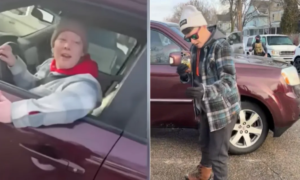
The clip opens with the camera fixed on a maroon SUV parked along a quiet neighborhood street lined with older homes, bare trees, and patches of snow. As the agent slowly approaches, a dog is visible in the window of the vehicle.
Inside the driver’s seat is Renee Good, wearing a dark hat and a light-colored jacket over a red cloth. She looks toward the agent, smiles, and gestures with her hands.
Her voice is calm but firm.
“That’s fine, dude, I’m not mad at you,” she says.
As the agent moves toward the rear of the vehicle, Good adds, “Big boy, show your face.”
The camera zooms in on the back of the Honda Pilot, lingering on the taillights, model badge, and Minnesota license plate. Several bumper stickers are visible. Another woman appears behind the vehicle, also recording on her phone. In a sarcastic tone, she says:
“That’s okay, we don’t change our plates every morning. Just so you know, it’ll be the same plate when you come talk to us later.”
As the agent walks away, the woman adds, “You want to come at us? I said go get yourself some lunch, big boy.”
Moments later, the camera pans up the street, showing several people in winter coats and a dark gray sedan positioned farther ahead. From that direction, another agent can be heard shouting:
“Get out of the car. Get out of the [expletive] car.”
The view snaps back to the maroon SUV. As the woman outside approaches the driver’s door, the vehicle begins to move. A loud crash follows—then two gunshots.
The footage ends abruptly, showing scuff marks on the vehicle and a now-emptier stretch of street. No further dialogue is captured.
Who Renee Good Was
In the days following the shooting, Good’s wife, Becca Good, released her first public statement, describing her partner not as a threat—but as a poet, a mother, and a woman who radiated warmth.
“She literally sparkled,” she said. “I mean, she didn’t wear glitter, but I swear she had sparkles coming out of her pores.”
Becca Good described her wife as deeply guided by compassion and faith.
“Renee was a Christian who knew that all religions teach the same essential truth: we are here to love each other, care for each other, and keep each other safe and whole.”
Those beliefs, she said, are what led the couple to stop during the ICE operation on January 7, despite being relatively new to the area.
“We had whistles,” she said. “They had guns.”
Renee Good was 37 years old, a U.S. citizen born in Colorado, and had no criminal history beyond a traffic citation. She was a published poet and a graduate of Old Dominion University, where she earned a degree in English and creative writing and won the school’s undergraduate poetry prize.
She leaves behind a 6-year-old son, now an orphan. His father, comedian Tim Macklin Jr., died in 2023—also at age 37.
Good’s mother, Donna Ganger, described her daughter as “one of the kindest people I’ve ever known” and “extremely compassionate,” rejecting the federal characterization of her actions.
“She was probably terrified,” Ganger said.
Conflicting Accounts and Public Reaction
Federal officials have described Good as a “domestic terrorist” who “weaponized her vehicle” against officers. The Department of Homeland Security has framed the shooting as an act of self-defense.
However, the video—showing Good smiling, speaking calmly, and engaging in what appears to be verbal protest—has fueled widespread skepticism.
Minneapolis Mayor Jacob Frey publicly dismissed the federal explanation, while Minnesota Governor Tim Walz labeled it “propaganda.”
Community leaders, family members, and civil rights advocates argue that the footage raises serious doubts about whether lethal force was necessary.
Unanswered Questions
The agent-filmed video and multiple bystander recordings provide unprecedented insight into the final moments before Good’s death. Yet fundamental questions remain:
-
Why did the situation escalate so quickly?
-
Was lethal force necessary?
-
Could de-escalation have prevented this outcome?
As federal and local investigations continue, Good’s final words—“That’s fine, dude, I’m not mad at you”—and her smile in those opening moments stand in stark contrast to the violent end that followed less than a minute later.
The footage has become a rallying point for those demanding accountability and transparency in federal enforcement operations, and a painful reminder of a life cut short and a family forever changed.
Related Posts
-
 Tom Noonan, Star of Manhunter and RoboCop 2, Dies at 74 Remembering the Legacy of a Unique Hollywood Character Actor
-
 Claudia Cardinale Has Passed Away: Farewell to a Cinema Legend
-
 Ed Sheeran Makes Heartfelt Visit to Melbourne Children’s Hospital Between Stadium Shows
-
 Al Pacino and Robert De Niro Pay Emotional Tribute to Robert Duvall After His Death at 95
About The Author